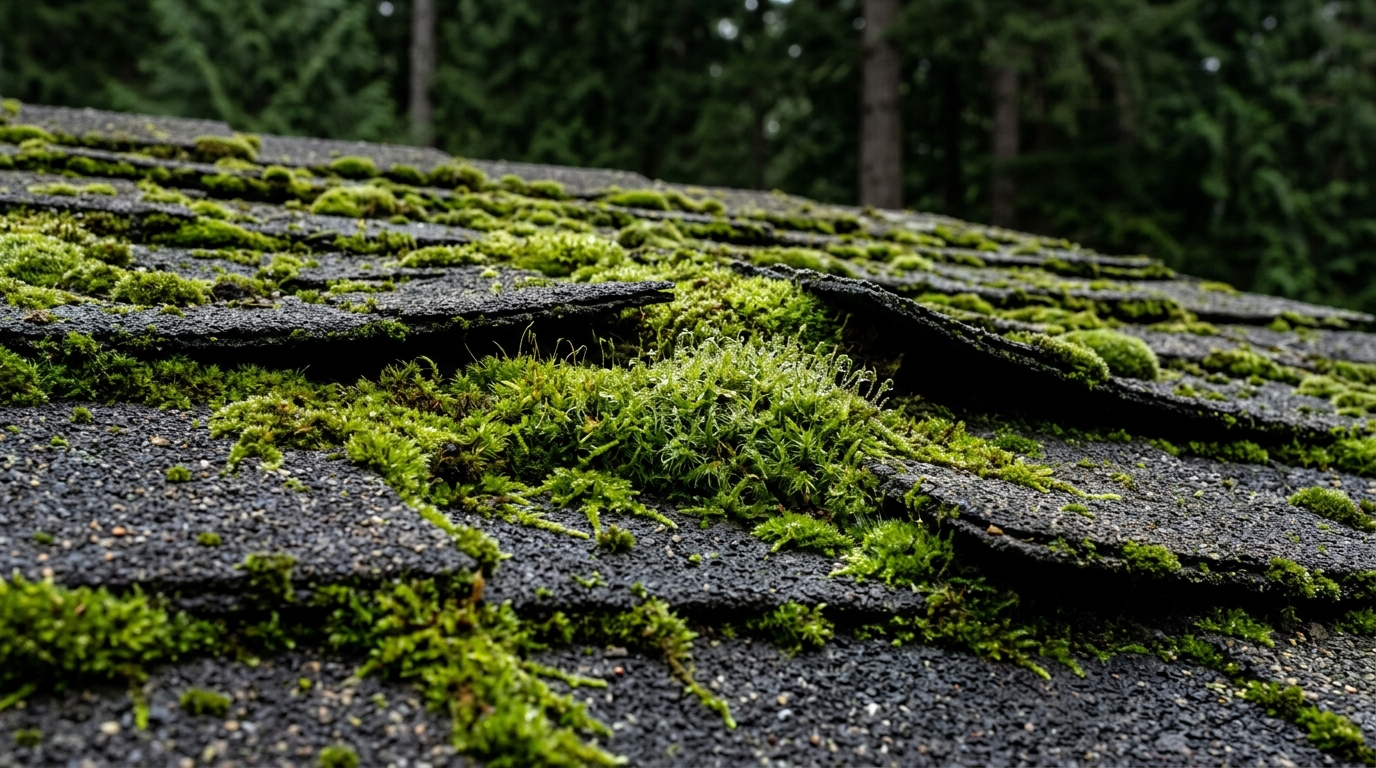
Moss grows on roofs across the Pacific Northwest because the conditions are nearly perfect: mild temperatures, consistent moisture, shade from overcast skies and surrounding trees, and organic debris that gives spores something to anchor to. In Burien specifically, the proximity to Puget Sound adds humidity that accelerates growth even on homes with good sun exposure.
The challenge is that moss can look harmless — even charming — for years before it starts causing real structural damage. By the time water stains appear on your ceiling, the moss has usually been working against your roof for a long time.
The early signs most homeowners miss
Most people don't notice moss until it's thick enough to see from the street. But there are earlier warning signs you can catch with a quick inspection:
Green discoloration on the north-facing slope
The north side of your roof gets the least direct sunlight in the Northern Hemisphere, making it the first place moss colonizes. Walk to the north side of your property and look up. If the shingles have a green or yellow-green tint — different from the rest of the roof — moss is establishing itself.
This early-stage growth is thin and flat, often mistaken for algae (which causes black streaks, not green). At this stage, a professional treatment can clear it before it causes any damage.
Thickened lines between shingle rows
Moss prefers the gaps between shingle rows, where moisture collects and organic debris settles. If the lines between your shingle courses look thicker or slightly raised compared to the rest of the roof, moss is growing in those gaps and beginning to push shingles apart.
This is when moss transitions from cosmetic to structural. Once it lifts a shingle edge, water can enter underneath, and the damage accelerates.
Granules in your gutters
Every asphalt shingle sheds some granules over its lifetime — that's normal. But excessive granule loss, especially concentrated on one side of the roof, can indicate that moss is breaking the bond between granules and the shingle surface. Check your gutters and downspout splash blocks for accumulations of dark, sand-like granules.
Shingle edges that don't lie flat
Healthy shingles lie flat against each other with a sealed bond. If you can see shingle edges lifting — even slightly — at the butt end (the exposed bottom edge), moss roots have likely broken the adhesive seal. Once that seal is broken, wind can catch the edge and peel the shingle further.
When moss becomes dangerous
Not all moss growth requires immediate treatment. Here's a rough guide to severity:
- Early stage (thin film, green tint) — Cosmetic. No structural damage yet. Good time for preventative treatment. This stage can last 1–3 years before progressing.
- Moderate (visible clumps, lifted edges) — Active damage beginning. Moss is holding moisture against the roof and beginning to lift shingles. Professional removal recommended within the next few months.
- Severe (thick mats, exposed decking) — Structural damage likely. Shingles are compromised, and the roof deck may be retaining moisture. Professional removal and repair needed promptly.
Why you shouldn't pressure wash your roof
Every year, we see roofs damaged by well-meaning homeowners or handymen who pressure wash moss off the surface. Pressure washing strips the protective granules from asphalt shingles, cuts into cedar shake grain, and can force water under shingles and into the roof deck.
A pressure washer can remove more roof life in 30 minutes than five years of PNW weather. Professional soft-wash moss removal uses low-pressure rinsing combined with targeted chemical treatment to clear moss without harming the roofing material.
Preventing moss growth
Once your roof is clear, prevention is more cost-effective than repeated removal:
- Zinc or copper ridge strips — Metal strips installed along the roof ridge release trace amounts of metal oxide when it rains, creating a surface that inhibits moss growth. Zinc strips typically last 15–20 years.
- Tree trimming — Reducing shade on the roof surface by trimming overhanging branches makes conditions less favorable for moss.
- Debris clearance — Keeping leaves and needles off the roof surface removes the organic material moss spores need to establish.
- Annual inspection — A yearly check, especially in spring after the wet season, catches new growth before it becomes established.
By the time water stains appear on your ceiling, moss has usually been working against your roof for years. The damage happens slowly, then all at once.
When to call a professional
If you can see moss from the ground — not just discoloration, but visible texture or clumps — it's worth a professional assessment. Our moss removal service includes a full roof inspection, gentle removal, eco-friendly treatment, and zinc strip installation for long-term prevention.
For Burien and King County homeowners, we offer dedicated moss assessments. We'll tell you honestly whether treatment is needed now, or if you can safely wait.
Worried about moss on your roof?
Get a moss assessment and estimate from K-Roofing & Repair. We'll inspect your roof and give you honest advice — no obligation.
Schedule assessment